
A tube laser cutter is not a simple “off-the-shelf” machine. Every workshop cuts different materials, lengths, wall thicknesses, profiles and production volumes, so choosing the right machine starts with understanding your real production needs, not just reading a generic specification sheet. At FABERTEC, we believe one of the biggest mistakes companies make is buying a standard cheap machine without properly checking future workload, material sizes, production targets, workshop space and expansion plans. This often leads to reduced productivity, higher wear, limited capability and expensive upgrades a few years later.
That is why every T4 Tube Cutter is specified after analysing tube and profile types, structural sections, material weights, wall thicknesses, production volume, finished component lengths, automation requirements, welding preparation needs and future growth plans, allowing the machine to be configured with the right reserve capacity, structural rigidity and drive systems for long-term industrial use.
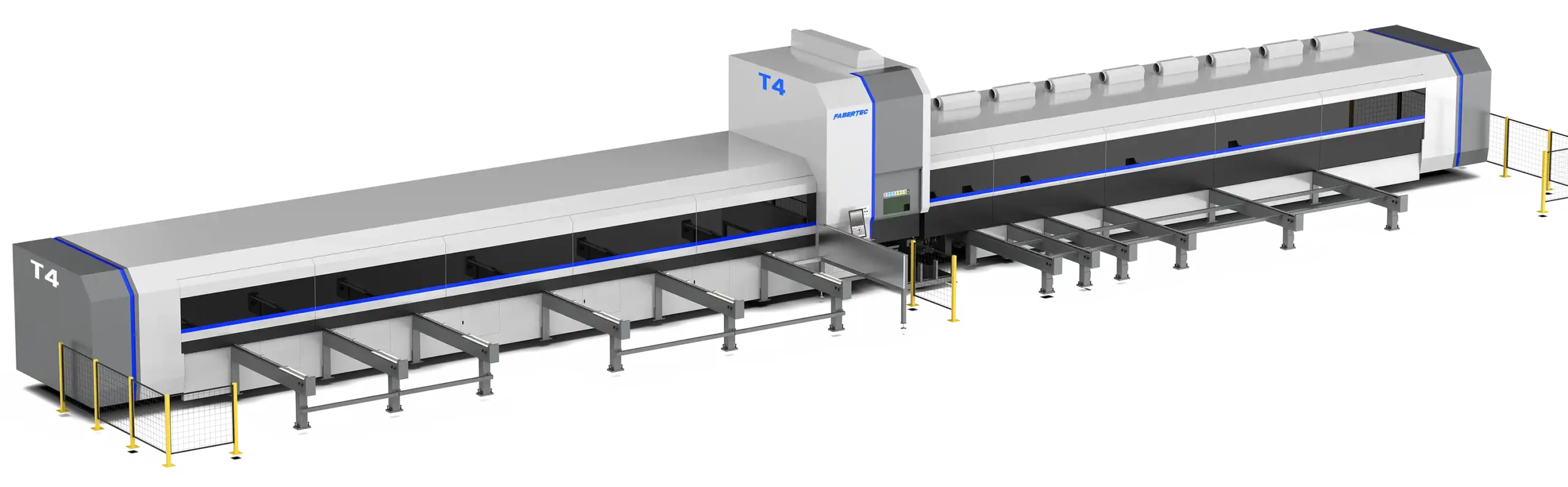
Loading and Outgoing Areas
Tube lengths vary massively between industries. Some clients process 3 metre sections, while others require 12–15 metre loading capability or even bespoke systems exceeding 20 metres.
The loading area directly affects:
- Operator involvement
- Batch efficiency
- Automation potential
- Production speed
- Workshop workflow
Longer loading areas allow multiple cutting operations before reloading is required, significantly reducing manual intervention.
Where workshop space is limited, 6m or 7.5m loading systems are often the most practical solution. However, for high-volume production facilities, extended loading systems can dramatically improve throughput and labour efficiency.
The outgoing section must also match the finished product size. Short finished components may only require basic support systems, while longer structural elements often require a third chuck and extended support assemblies to maintain precision and prevent deflection during processing.
The T4 platform can also be configured with:
- Zero tailing systems
- Automated loading
- Automated unloading
- Extended support rails
- Bespoke transfer systems
Chuck Selection and Structural Capacity
The chuck system is one of the most critical parts of any tube laser cutter.
Different industries require vastly different chuck capacities:
- Small precision tubes
- Heavy structural steel
- Thick-wall RHS/SHS
- I-beams
- U-channels
- Oil & gas pipework
Chuck diameters can range from compact 80mm systems up to heavy-duty 600mm industrial chucks.
To correctly size the chuck system, we analyse:
- Tube diameter range
- Kg per metre
- Total section weight
- Material inertia
- Rotation speed requirements
- Daily production targets
- Finished product dimensions
This data allows us to correctly match:
- Servo motor size
- Gear reducers
- Structural support systems
- Rotational acceleration capability
- Long-term durability
Undersized drive systems may work initially but often wear prematurely under industrial production loads. The T4 tube cutter philosophy is to overspecify critical components to maintain reliability and reduce downtime.

Tube Support Systems
The tube supports work together with the chuck system to maintain material stability throughout the cutting cycle.
Without properly synchronised support systems:
- Long tubes sag
- Rotation becomes unstable
- Cutting accuracy suffers
- Chuck strain increases
- Servo wear accelerates
The T4 uses synchronised multi-point support systems designed to stabilise:
- Round tube
- SHS/RHS
- Angle iron
- Structural profiles
- Heavy wall sections
This ensures accurate positioning and consistent cutting quality across the entire material length.
A properly supported tube also reduces vibration during rotation and cutting, especially on longer or heavier sections. This helps protect the chuck system, reduces unnecessary stress on moving parts, and gives the operator more consistent results from the first cut to the last.
Servo Motors and Reducers
Most tube cutter problems originate from undersized motion systems.
High rotational mass combined with rapid acceleration creates enormous strain on:
- Servo motors
- Gear reducers
- Bearings
- Chuck assemblies
At FABERTEC, servo systems are selected with significant reserve capacity rather than operating at the edge of their limits.
Our engineering philosophy is simple:
- Oversize critical systems
- Reduce mechanical stress
- Extend component lifespan
- Minimise production stoppages
This becomes especially important when processing:
- Heavy structural steel
- Thick-wall material
- Long sections
- High-volume production runs
Laser Power and Future Capacity
Laser power selection is not only about current cutting thickness.
It must also account for:
- Future workload increases
- Production speed targets
- Material expansion plans
- Bevel cutting requirements
- Weld preparation capability
For example, a 6kW machine may process 15mm wall material adequately, but once bevel cutting or weld preparation is introduced, effective cutting requirements increase significantly.
Upgrading to 12kW can provide:
- Faster processing speeds
- Higher daily throughput
- Better bevel capability
- Increased future flexibility
- Greater spare cutting capacity
Selecting the correct laser source from the beginning avoids production bottlenecks later as the business expands.
Loading and Unloading Automation
The T4 tube cutter can be configured with automated loading and unloading systems designed around production volume and material dimensions.
Automated loading systems can:
- Store multiple sections
- Automatically feed material
- Reduce operator involvement
- Improve consistency
- Lower labour costs
Automated unloading systems:
- Protect finished parts
- Improve workflow
- Prevent floor clutter
- Increase production efficiency
Every automation system is matched to:
- Material length
- Section type
- Finished product size
- Production targets

Bespoke Engineering Solutions
No two fabrication workshops operate identically.
That is why the T4 platform also supports:
- Water assist cutting systems
- Internal scrap extraction
- Deburring systems
- Bespoke handling systems
- Special structural configurations
- Custom automation solutions
By maintaining an in-house engineering and machine design department, FABERTEC works directly with clients to configure the most efficient and commercially viable solution for their operation.
The goal is not simply to sell a machine. The goal is to engineer a production system that remains commercially viable, productive and scalable for years ahead.
Software and Operator Flexibility
Every T4 system includes operating software without forced subscription models.
The supplied software supports:
- Tube cutting
- SHS/RHS profiles
- Oval tube
- Standard structural sections
Clients can optionally upgrade to advanced Tube-T software packages depending on their production requirements and nesting complexity.
Bevel & Static Cutting Technology
For fabrication companies producing welded assemblies, bevel capability is often essential rather than optional.
The bevel cutting option transforms the T4 into a full production preparation system capable of:
- Weld preparation
- Chamfers
- Complex inserts
- Multi-axis profiling
The additional axes significantly reduce manual preparation time while improving repeatability and weld consistency.
The static cutting axis also allows the laser head to move independently along the tube without constantly moving heavy material in and out through the chuck system. This:
- Reduces energy usage
- Improves acceleration
- Increases cutting speed
- Reduces mechanical wear
Moving a lightweight laser axis is substantially faster and more efficient than repeatedly repositioning heavy steel sections.